

.jpg)
The Hidden Costs of Cheap Self-Service Kiosks (And How to Avoid Them)
When comparing kiosk suppliers, it's natural for procurement professionals to focus almost solely...
It’s no secret that the Quick Service Restaurant sector is a highly demanding industry. It’s defined by intensive, fast-paced environments where throughput, consistency and brand differentiation are all key to success. Just to make it more challenging, the technology is constantly evolving - as are customer expectations.
Digital solutions are obviously one of the most useful tools at a QSR’s disposal to help continue meeting these challenges. In recent years, more and more QSRs across the United States have been looking more closely at Original Equipment Manufacturing (OEM), and how it can help them to achieve their own commercial goals. In that respect, it offers a wide range of useful benefits compared to more generic, off-the-shelf equipment. We’ll take a look at some of the biggest ones below. Before that though, let’s start off with a quick recap.
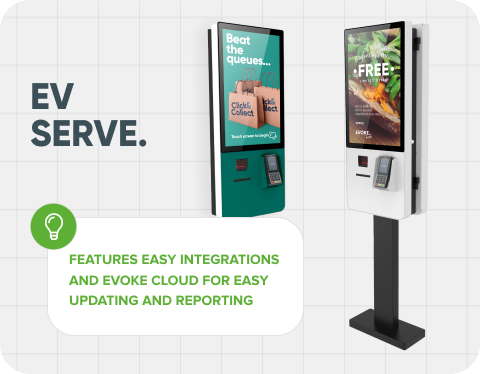
Original Equipment Manufacturing refers to the process of an external specialist designing and manufacturing a custom solution for a specific QSR, which the latter will then roll out under its own brand. Within the Quick Service Restaurant sector, this can include self-service kiosks, drive-thru technology, digital ordering systems and payment hardware.
It’s an approach that provides valuable simplicity and flexibility for QSRs, mainly by helping to keep the design, manufacturing and rollout process under one roof. Perhaps the biggest difference between OEM and traditional restaurant equipment buying is that it also gives QSR brands more control - enabling decision-makers to tailor their solutions to their own service model and customer journey. For example, this could involve changing the physical design of a kiosk, creating a simpler ordering flow, adding branded finishes, or building hardware around the space available in their restaurants.
Those are the advantages in broad strokes - now let’s drill down a bit more closely into the more specific benefits that OEM can provide for QSRs.
During large-scale rollouts, any delays between design, manufacturing and deployment can all start to make a noticeable impact on costs, and slow down the overall progress - as you may have found yourself. Original Equipment Manufacturing provides a useful way for QSR brands to keep all these stages connected via one external partner, helping them move more smoothly from concept to rollout.
That’s particularly valuable when a QSR brand needs to deploy the same technology across multiple restaurants, refurbish an existing site, or launch a new restaurant format. An external specialist can use repeatable production processes to manufacture and roll out the same hardware across every location, while reducing the need for any ongoing re-design work, or last-minute adjustments during installation.
Plus, if a QSR brand plans on reusing proven OEM hardware across multiple rollouts, that can go a long way to reducing the investment that might otherwise be required for new tooling, prototyping and R&D. One of the best related benefits of that is that it boosts scalability for the brand, by helping to create a smoother route to a rapid kiosk deployment for its new openings and refurbishment programs - all while still keeping the core setup consistent across its various locations.
The customer experience is obviously one of the most central pillars of the Quick Service Restaurant sector. Today’s customers expect ordering experiences that feel quick, intuitive and familiar. That puts more pressure on QSR brands to make these experiences feel consistent across every location and every touchpoint - whether their customers are using a self-service kiosk, ordering at a drive-thru, or collecting food inside the restaurant.
Original Equipment Manufacturing can help to facilitate this by making it easier for QSR brands to build their technology around the way their customers actually order. That means they can adjust individual elements like screen layouts, navigation, payment journeys and accessibility features; both to make the experience easier and more pleasant for their customers, and optimize for their own specific commercial goals in the hospitality sector.
Similarly, an OEM approach can also provide a brand with more control over the physical aspects of its solutions. Queue-line foot print, kiosk dimensions and collection-point placement - they’re all just a few examples of what can affect the movement of customers through busy restaurant environments, particularly during peak trading periods. It’s also worth noting that some customers will interact with the technology differently, depending on whether they’re ordering on the move, carrying heavy bags, collecting large orders, or using drive-thru lanes. The physical layout and ergonomics of the technology can have a direct impact on their perceptions of how easy the hardware is to use, and OEM can provide QSR brands with valuable opportunities to refine it with this in mind.
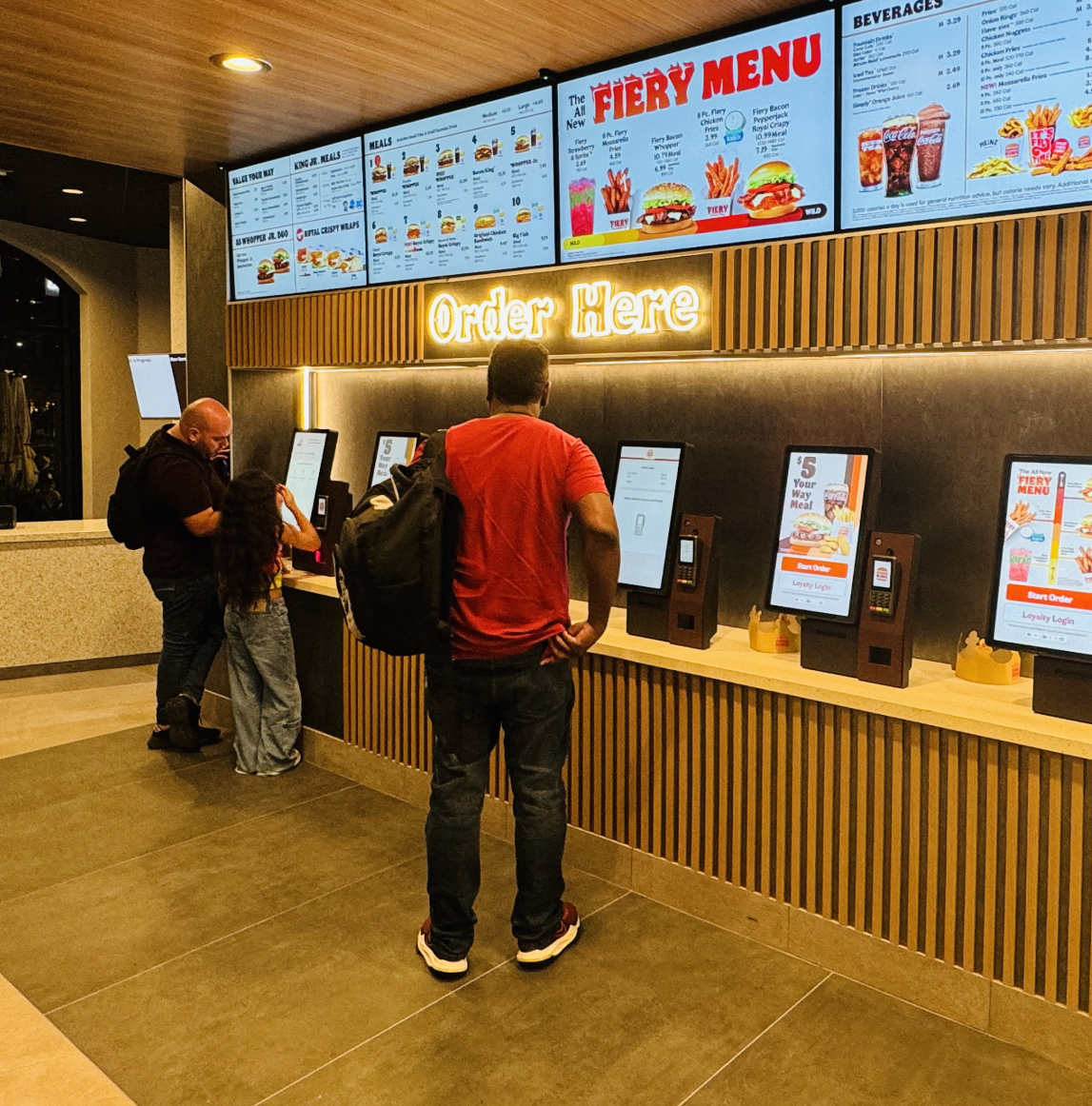
Talk with our team to explore custom kiosk solutions designed to meet your specific operational goals.
As well as the experience for customers, digital ordering solutions can also provide direct benefits to staff, too. For example, they can affect how in-house teams are able to manage lines, prepare orders, and move customers through the restaurant during busy service periods. Any small delays or friction points between those stages can quickly start to affect throughput, waiting times and operational efficiency across the entire site.
OEM can help QSR brands to avoid that by enabling them to build their technology around their own specific processes. Kitchen Display Systems, payment terminals, customer-facing displays and hardware layouts are all examples of elements that a brand can tailor to its kitchen workflows and front-of-house environments. This can be particularly useful in restaurants with limited floorspace, where the layout needs to be carefully optimized to ensure that there are no obstructions or chokepoints for staff, and that they can quickly and easily access any devices they need to.
Now, so far a lot of the benefits we’ve been discussing have mainly been focused on the functionality advantages that Original Equipment Manufacturing can offer. However, that functionality segues quite neatly into boosting brand identity too.
This is largely because customer-facing technology now forms a core part of the brand experience for many QSR businesses. It’s worth highlighting that self-service kiosks and digital ordering systems are classed as touchpoints because they are instances in which customers interact directly with a brand. So by definition, each touchpoint provides an opportunity to reinforce the brand’s visual identity, values, and USPs.
In terms of strengthening brand identity, OEM provides several avenues of approach. These include:
These are just a few examples. When effectively implemented, all of them can essentially form part of the wider brand experience, helping the technology to feel more connected to the restaurant itself. That can go a long way toward building brand awareness and long-term loyalty from customers.
Most QSR brands will often start considering Original Equipment Manufacturing after a period of growth, especially if they notice that standard off-the-shelf technology now isn’t capable of accommodating their evolving requirements. For example, off-the-shelf kiosk hardware may not fit the available counter or floor space, or the build may not be durable enough to withstand high-footfall service. It might simply not be scalable enough. Issues like these can become especially noticeable during expansion programs, refurbishment projects or wider digital rollouts, where QSR teams need greater consistency and more control across multiple locations and restaurant formats.
Once the need for a new solution has been identified, the next step for most QSR brands is to start looking more closely at the measurable operational and commercial impact that OEM could have across their wider business. This involves assessing a few key metrics, including:
All of these can help decision-makers to evaluate whether a more tailored solution could provide more long-term value to the business as a whole. It’s not unusual for QSR brands to test this by carrying out a pilot across a small store cohort, so that they can assess the impact before committing to a wider rollout. One of the main things that they’ll look at is how the technology performs during live service, and whether it’s able to provide the operational consistency and customer experience that the brand expects. If the trial is a success, it can then form the basis for a more large-scale rollout.
If you’re considering adopting Original Equipment Manufacturing into your own processes, we’re here to help at Evoke Creative. We design, implement, and roll out custom solutions that are geared toward achieving your specific commercial goals, and our wide-ranging expertise means that our team can handle everything from project management and rollout to ongoing service and maintenance. Whatever problems you need to solve, and whatever your vision for the future of your business, you can count on us to make it a reality.
When comparing kiosk suppliers, it's natural for procurement professionals to focus almost solely...
Speed and efficiency have always been pretty important to success in the fast-paced, highly intense...
-3.jpg)
Not since the invention of the drive-thru has the quick service restaurant (QSR) industry...