

.jpg)
The Hidden Costs of Cheap Self-Service Kiosks (And How to Avoid Them)
When comparing kiosk suppliers, it's natural for procurement professionals to focus almost solely...
Kiosk investment is often centered around one question: “How much does a restaurant self-ordering kiosk cost?”.
Which is to be expected, after all, these investments are significant and come with a degree of risk if the vendor or restaurant doesn’t properly manage the installation and rollout of the kiosk estate.
The truth is that there is no one-size-fits-all cost because not all restaurants are the same, be that in layout, customer preferences, or the number of locations they have. An investment by a small boutique chain with half a dozen restaurants situated in a local area will be totally different from a household quick service restaurant (QSR) with thousands of locations across America.
Cost depends on what you’re getting from your kiosk investment and how you intend to use it. Therefore, restaurant leaders need to think beyond unit cost and examine:
Here, we’ll unpack every aspect of restaurant kiosk costs so that you can appreciate what the total cost of ownership looks like and understand why long-term value beats short-term savings.
The starting price for a base-level restaurant self-ordering kiosk is around $1,600 USD. However, total costs will almost certainly vary depending on the deployment needs, as well as the software inside the kiosk, and the hardware that makes up the outside of it.
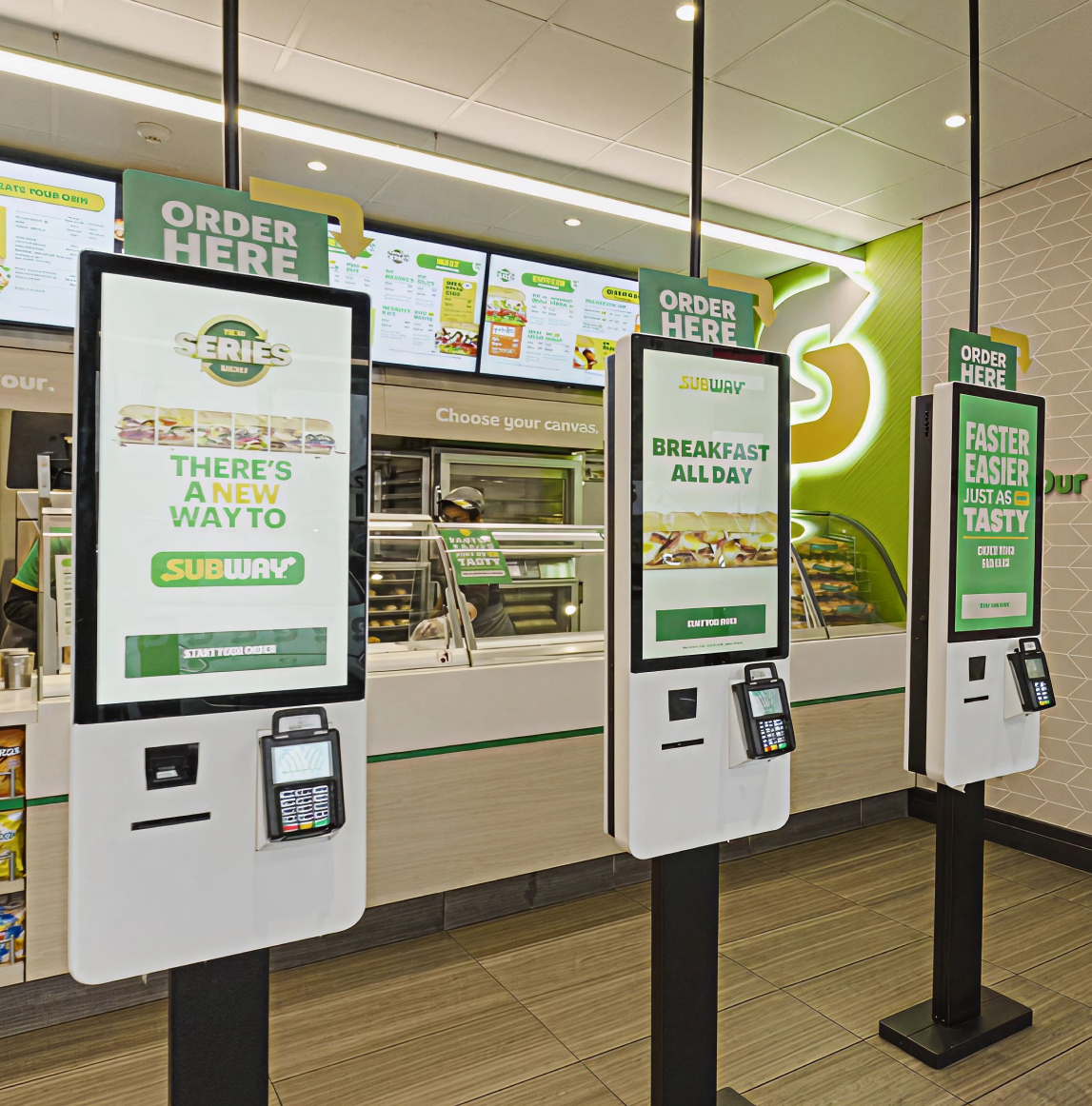
Evoke offers a range of kiosk models, all of which are designed with specific use cases in mind so that every restaurant can benefit from the business transformation this hardware provides.
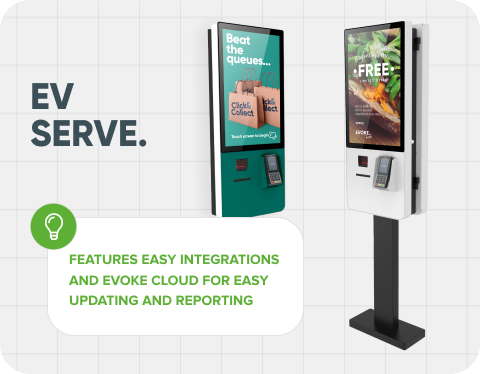
For example, the evFlyte is our most cost-efficient unit and can be wall-mounted, added to countertops, or freestanding, whereas the evServe’s 27-inch display and robust freestanding frame make it a more premium solution.
The physical format of these kiosks also significantly impacts the cost, with more hardware tending to mean greater investment. Freestanding units, for example, cost more because of their leg stands, whereas countertop units are more compact and likely to suit restaurants with stringent budgets.
Another key element that can increase cost is the hardware that makes these kiosks so transformative for the customer experience. The type of processor used can impact the overall cost and performance of your solution. N95 chips offer a more cost-efficient route for many standard use cases, while Intel i7 units deliver greater processing power for more intensive applications. As a software-agnostic provider, we support both Windows and Android operating systems, recognizing that software demands often dictate hardware choices. Whether your application is better suited to Windows or Android, our team will help specify the right hardware stack to ensure optimal performance.. Add-ons such as printers that can distribute physical receipts and order numbers to customers, which may be required by US restaurants, can also increase the final price.
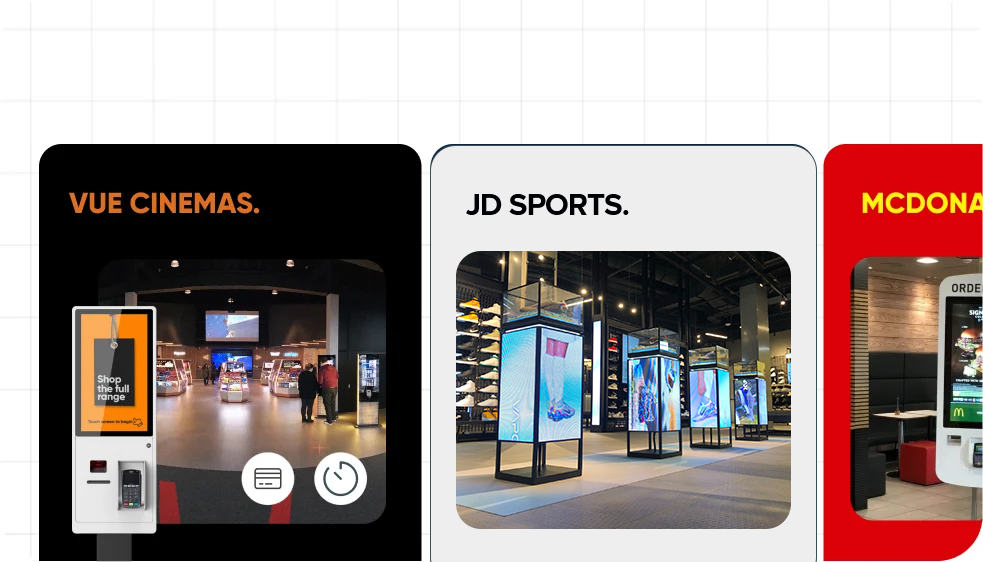
Finally, the number of kiosks required will also dramatically affect the final cost. Brands wanting 100 or more kiosks will benefit from economies of scale, with per-unit cost reducing significantly. Evoke has worked with global restaurant brands such as McDonald's, which themselves benefited from bulk buying and tailor-made kiosks that made large-scale rollout viable.
When investing in self-ordering kiosks, restaurants typically choose between two financing models: capital expenditure (CapEx) or operational expenditure (OpEx).
CapEx involves an upfront investment where the restaurant owns the hardware from day one. This approach is common among enterprise-level operators, especially in North America, as it provides full ownership, long-term cost control, and simplified asset management.
OpEx models, often delivered as software-as-a-service (SaaS), spread costs monthly or annually and typically bundle in other features like support. This approach is more common among small-to-medium-sized brands or outside North America, where cash flow flexibility and lower upfront costs are a priority.
The right model depends on the restaurant’s scale and financial strategy. While CapEx offers better value over a multi-year period, OpEx provides a lower barrier to entry which is particularly useful for growing or franchised brands.
When budgeting for kiosks, restaurant leaders must know what is included in the quote, with the hardware price typically covering:
Rather than offering full custom (ODM) units which is something that’s not typically required in the QSR or fast casual space, at Evoke, we provide three proven, scalable kiosk models. Each is designed with modular flexibility, allowing you to tailor key hardware components to your operational and design needs.
Importantly, most quotes do not automatically include features separate from the kiosks themselves, such as:
These sorts of extras are often scoped separately or offered as part of a broader package, further emphasising the point that the quote is just one, albeit significant, part of the overall kiosk cost.
Clarity is key and is something that new partners enjoy when they work with Evoke. We’re transparent about what is included from day one so that you can invest confidently, knowing exactly what your outlay will be.
A key area overlooked by many in restaurant leadership positions is the ongoing cost of a kiosk estate. Kiosks, like any piece of tech, have lifespans and will inevitably require maintenance the more they are used by customers.
Over time and with extensive use, screens may break or printers may need replacing, all of which requires thought about not just how much the repair costs, but how it will affect the customer’s experience. The right kiosk vendor will work with a new client to factor in scheduled maintenance and upgrades to their kiosk estate in a way that doesn’t limit the benefits of them.
Two common models are used to deal with maintenance:
Software or operating system updates that need physical changes to the hardware, which are needed to keep in line with changing customer expectations, are also another consideration.
Evoke’s remote diagnostic capabilities help to mitigate this issue by allowing leaders to carry out remote monitoring of the entire kiosk estate and fix issues or update campaign assets without the need to increase downtime.
Kiosks need to be installed once they are purchased, the cost of which can add up for multi-site rollouts in restaurants that don’t have a consistent footprint across branches. Initial site surveys need to be undertaken to avoid issues at the installation phase, and if these surveys recommend installation after normal business hours, this too needs to be budgeted for.
Modern kiosks need to be as accessible as possible in line with the Americans with Disabilities Act of 1990 (ADA). To ensure compliance, additional features need to be considered, such as headphone compatibility and support for screen readers. Evoke’s kiosks are all built in line with both the ADA in North America and the EAA for Europe, resulting in no additional cost surprises.
These costs don’t need to be overlooked. With the right partner by your side, you’ll have clarity about the ongoing, additional investment needed. The way to view kiosks is as something that forms a three to five-year strategy of customer experience transformation, not just a typical one-time tech purchase.
The real benefits of a kiosk are what it returns for your restaurant, which is more than just improvements to its bottom line.
|
1. Higher Average Order Value |
Customers spend more when they have the time to browse offers and personalized upsells without the pressure from a queue forming behind them. |
|
2. Reduced Staffing Costs |
Kiosks allow existing staff to be redeployed to food prep or carry out more valuable customer service at peak hours. |
|
3. Shorter Queues |
Kiosks reduce the need for people to queue, and a reduction in long lines improves the number of orders being made and keeps customers happy. |
|
4. Improved Order Accuracy |
Customers with allergies or specific preferences can tailor their order to their exact specifications and not worry about any miscommunication. |
Kiosks also serve as a marketing channel that can show promotions and offers directly on the screen, both at the start of the customer’s journey and throughout it. The rising costs associated with printing and distribution, as well as the unexpected ones that come from printing misruns or spelling errors, are eliminated overnight. Any promotional content can also be updated across the whole kiosk estate from one device, thanks to the Evoke Cloud.
Fundamentally, true ROI is all dependent on execution. It needs to combine a good user experience with proper kiosk placements and a thorough consideration of points of sale and kitchen workflows.
A common, costly myth is that kiosks are basically all the same, no matter how much they cost.
In reality, the quality of the hardware and the additional extras can positively impact the customer experience, which is really the only thing that decides whether or not people are going to come back and use them.
Operators too often compare consumer-grade tablets on stands to commercial-grade kiosks, with many thinking ‘a screen’s a screen’ so why spend thousands of dollars on them if an iPad can do the same job? $500 commercial tablets are not built for high-speed commercial environments, nor do they offer the same levels of user experience that American consumers are familiar with in other environments, such as hotels or retail stores.
“One of the biggest misconceptions we see is the assumption that a $500 kiosk can do the same job as a $2,000 one. In reality, quality, durability, and user experience are directly tied to build and component choices. There’s no shortcut when it comes to lasting performance in high-traffic environments.”
Kyle Krulac, Vice President, North America - Evoke Creative
It might be tempting to go for the ‘cheaper’ option, but this often results in higher support costs and more frequent failures because tablets can’t keep up with the customer throughput of a modern quick-service restaurant. Ultimately, these cheaper alternatives only serve to annoy customers who are already thinking about which competitor restaurant they’ll visit next time.
A kiosk estate’s impact on your day-to-day operations is just too important for it to be considered as anything other than a multi-year investment that will provide you with a return that far outweighs the initial cost.
The total cost should always include:
Evoke helped global brands McDonald's and Subway pilot their kiosks before rolling them out to the entire estate. This pilot helped iron out any initial issues without causing significant negative brand sentiment to grow.
This ‘slow down to speed up’ phase ensures that kiosks can go live at scale seamlessly without any nasty surprises. Evoke doesn’t just ship kiosks, though. We partner with you on restaurant guest experience design via site surveys, as well as helping to define the service-level agreement, including post-sale support strategies.
Evoke brings 20+ years of experience helping brands in North America and across the world scale kiosk rollout that delivers outstanding business results.
With our help, we’ll turn your restaurant’s kiosk project into something that becomes a strategic asset rather than just another tech project. We’ll partner with you and be on hand throughout the process from pre- to post-installation so that the value of your new kiosks outweighs the true cost of them.
When comparing kiosk suppliers, it's natural for procurement professionals to focus almost solely...
Speed and efficiency have always been pretty important to success in the fast-paced, highly intense...
-3.jpg)
Not since the invention of the drive-thru has the quick service restaurant (QSR) industry...